

From Science Matters
By Ron Clutz
At Real Clear Energy, Ross Pomeroy writes insights from Vaclav Smil An Interview With Vaclav Smil on Small Nuclear Reactors, a Fertility ‘Crisis’, and More. Excerpts in italics with my bolds.
There is perhaps no scholar more qualified to dissect the world’s energy systems on a macro scale – from food and agriculture to electricity and fuel – than Vaclav Smil. The 81-year-old Distinguished Professor Emeritus in the Faculty of Environment at the University of Manitoba has been researching how humanity has developed, transformed, and used energy for over a half-century. And to our collective benefit, he doesn’t keep what he’s learned to himself. Smil has written fifty books. (His latest was just released in April.)

Smil’s up-to-date and encyclopedic knowledge on humanity’s energy use, coupled with his longevity in the field, make him uniquely positioned to render learned prognostications on the future of Earth’s ever-changing energy, material, and environmental systems. He graciously took the time to answer a few questions for RealClearScience on topics ranging from small nuclear reactors, to climate adaptation, to humanity’s much-debated fertility “crisis.”
RP: Market valuations for small modular reactor companies such as Oklo and Nuscale have ballooned over the past year to roughly $10 billion for each despite the fact that these firms have never built a commercial nuclear reactor. Do you think hype has gotten ahead of reality here? How likely do you think it is that small modular reactors will be deployed in the next decade? What are some open challenges?
VS: This is just the latest (and perhaps the craziest) chapter in an old tale. I heard first about small nuclear reactors more than 40 years ago from Alvin Weinberg (a Manhattan project participant, co-inventor of pressurized water reactor and a director of the Oak Ridge National Laboratory (ORNL)). When Congress ended the funding of a liquid metal fast breeder reactor in 1983 (in the wake of the Three Mile Island accident and huge cost overruns for large nuclear plants), ORNL began to promote the idea of small, inherently safe reactors now known as SMRs (small modular reactors).
When asked about their future I have had a simple answer ever since the 1980s. First, I used to say, “give me a call,” then I changed that to “send me an e-mail” once you see such wonders built on schedule, on budget, and in aggregate capacities large enough to make a real difference to a country’s electricity supply (say at least 10% of the total).
US installed power capacity is now about 1.3 TW. Ten percent of that is 130 GW. Hence, even if SMRs were to average 100 MW, the US would need 1,300 of them to matter. If they averaged just 50 MW, then the country would need 2,600 of them. And that’s before we even consider rising electricity use.
Then think of dealing 1,300 or 3,000+ times with public acceptance, siting selections, NIMBY controversies and lawsuits, regulatory requirements, constructions schedules and major cost overruns (all major projects are notoriously prone to that fate). Obviously, that e-mail announcing SMRs making discernible difference, nationally or globally, is not coming during this decade . . . or the next one.
RP: Transitioning power generation to renewables garners most of the attention when it comes to addressing climate change, but you’ve pointed out that there are other major processes besides power generation that are extremely important and even more difficult to decarbonize. What are a few of these?
VS: Decarbonizing electricity generation is technically straightforward, with known conversions (now dominated by wind turbines and PV cells) and system arrangements (substantial storage and transmission). And there are other effective choices: the world still has a huge untapped hydro capacity, and a new generation of fission reactors could supply base demand. In contrast, decarbonizing what I have called the four pillars of modern civilization -– ammonia, steel, cement, and plastics -– is hard as there are no readily available technical fixes combining the needed output scale with affordability. Basic calculations reveal the extent of these global challenges.

Without Haber-Bosch synthesis of ammonia we could not, even with assiduous recycling of organic wastes, feed more than about half of humanity. This synthesis is now responsible for less than 2% of global CO₂ emissions, mostly from the production of hydrogen by natural gas reforming. Steel and cement are the two largest, indispensable infrastructural materials. Primary steel production is responsible for 7-9% of global CO₂ emissions, above all from blast furnaces fuelled by metallurgical coke. Cement production (calcination process) generates 7-8% of global CO₂ emissions. And now ubiquitous plastics add 4-6% of global CO₂ emissions from the energy-intensive production of petrochemicals used as feedstocks and energy sources. Together, these industries contribute 20-25% of total global CO₂ emissions. And then there are non-energy uses of fossil fuels as feedstocks required for plastics production as feedstocks and for lubricants (5-6% of total global primary energy use).
Synthesis of ammonia as well as the smelting of iron can rely on green hydrogen generated by electrolysis of water energized by renewably generated electricity. If you do your own stoichiometric calculations of hydrogen mass needed to produce annually about 180 million tons of ammonia and 1.35 billion tons of primary steel (by the reduction of iron oxides) you will end up with some 32 million tons of green hydrogen for ammonia and 75 million tons of green hydrogen for steel, 107 million tons in total.
In 2025, the global production of green ammonia will not surpass 5 million tons, less than 5% of today’s replacement demand -– but by 2050 that demand for rising ammonia and steel production might surpass 150 million tons of green hydrogen a year, requiring about 30-fold increase of electrolysis capacity in 25 years. This is technically doable but enormously challenging with total costs (most notably, building entirely new iron pellet reduction plants because the existing blast furnaces cannot work by burning green hydrogen instead of metallurgical coke) that remain to be determined. Meanwhile, 75 new blast furnaces began to work (mostly in China and India) since 2020 and dozens more are under development. Once lit, new furnaces produce hot metal in uninterrupted campaigns lasting 15-20 years. Moreover, in 2024 Nature Energy found a huge gap between the promise and the reality of new green hydrogen capacities: after tracking 190 projects over three years, they found only 7% of announced projects finished on schedule.
RP: Humanity, at this time, appears to be largely fixed within its current systems and resistant to the large-scale change and immense spending – estimated to be comparable to WWII yearly expenditures – that would be required to complete a global energy transition by 2050. Do you foresee anything steering humanity off of its current planet-heating course?

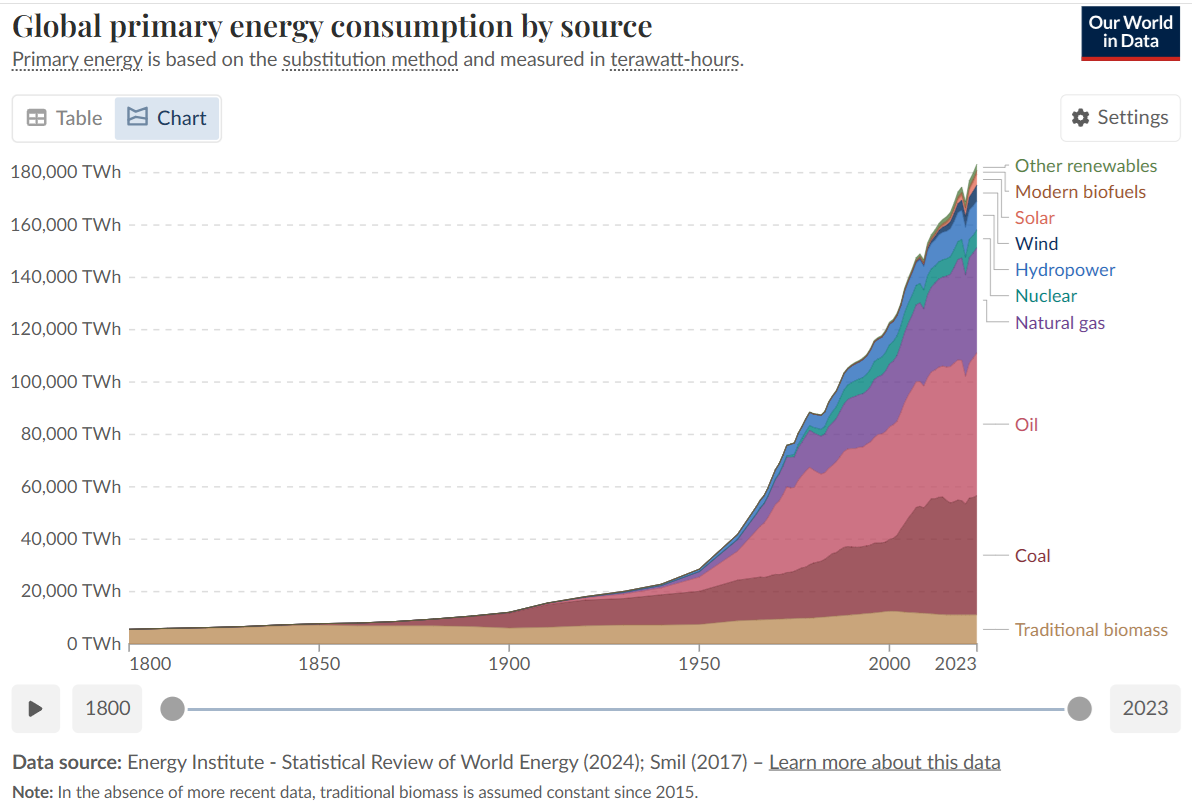
VS: Contrary to common impressions, there has been no absolute worldwide decarbonization. In fact, the very opposite is the case. The world has become much more reliant on fossil carbon. Global fossil fuel consumption rose by 62% between 1997 and 2025 while the share of fossil fuels in global energy consumption has decreased only marginally and it remains above 80 percent. Moreover, the first global energy transition, from traditional biomass fuels to fossil fuels, which started more than two centuries ago, remains incomplete, as about two billion people still rely on traditional biomass energies – mostly on fuelwood and crop residues in the countryside but also on inefficiently and destructively produced charcoal in cities. Replacing these energies will require even greater increases of renewably generated electricity.

In large-scale affairs, scale always rules. Wishful thinking may set the dates (usually years ending in zero or five) for specific national, regional or global decarbonizations (EU: no new internal combustion engines in 2035; world: net zero in 2050) but after increasing our reliance on fossil fuels by more than 60% during the past quarter century the chances of completely eliminating this dependence during the next 25 years appear extraordinarily unlikely.

RP: Is there a point that climate adaptation becomes a wiser strategy than climate mitigation?
VS: Let us stick to facts. Since the year 2000 more than 20 countries have reduced their CO2 or even their overall (CO2, CH4, N2O) emissions. But global emissions –- the only metric that matters because it is the total mass of greenhouses gases resident in the Earth’s atmosphere that determines the degree of warming — keep on rising. CO2 emissions from energy uses are the most reliably quantifiable flows. In 2024 they set yet another record, 1.3% above 2023 and they now approach 41 billion tons of CO2 equivalent a year, nearly 9% higher than a decade ago. Clearly, there has not been any mitigation (“the act of reducing a severity”) on the global level.

As for adaptation, wide-body jetliners bring record numbers of people to places already choked with other people. As you read this, cargo flights are bringing fresh blueberries from Peru to New York and just-caught tuna from the Indian Ocean around the Maldives to Tokyo. Go ahead and calculate the carbon costs and benefit ratios of such ventures (blueberries are 85% water and not even high in vitamin C). There is no “wiser strategy” –- there is no strategy (“a plan to achieve a major gain”). The greatest global success has been the rising share of renewably generated electricity (about 13% of the total in 2025) -– but the world now also generates more electricity from coal and natural gas than ever and hence the carbon emissions from this sector also keep on rising.

RP: You’ve previously touted efficiency as an unheralded yet highly effective method of reducing our impact on Earth’s systems, noting leaky water distribution, inefficient indoor heating, and nitrogen waste from fertilizers as problems ripe for innovation. Why don’t you think there’s been more of a widespread effort to boost efficiency in these arenas?
VS: Eventually, efficiencies always make the greatest difference. Here are just two prominent examples. The first gas turbine (1939) generated electricity with 17% efficiency, now Siemens will sell you one that is 64% efficient. Boeing 787 uses 69% less jet fuel per revenue passenger kilometer than did the first commercial Boeing 707 in 1958. But these gains are usually incremental, spanning decades. Light emitting diodes (LEDs) have been a notable exception.
Energy losses taking place in hundreds of millions of homes (heated in winter and air conditioned in summer), at billions of sites (leaking pipes), or over enormous areas (as denitrification bacteria in soils convert fertilizer nitrates into nitrogen gas) are an entirely different challenge to manage. Still, none of this can excuse the modern preference of throwing away billions on quests for dubious breakthroughs over-hyped by instant (and often instantly forgettable) start-ups rather than spending millions on good sensors to avoid excessive fertilizer applications and to seal leaking pipes or restrict excessive heating.
RP: Elon Musk and others have sounded the alarm about a looming fertility crisis resulting from humanity’s gradually declining fertility rate, which has fallen from almost five children per woman in 1965 to just over two today. What do you think about the declining fertility rate? Is it a “crisis”, something to be celebrated, or neither?
VS: Who is the arbiter of this global total? Who defines what is “desirable?” Who decides what constitutes a “crisis?” Elon Musk? In 1950, when I was a young boy, the global population was about 3 billion. Then the panic about endless growth set in and in 1960 Science (!) published a paper claiming that on Friday, 13 November, A.D. 2026 the Earth will have an infinite population! No wonder, by the late 1960s there were apocalyptic fears of massive famines. Yet then the death rates declined, life expectancies rose, mass famines ended, and today we have about 8.3 billion people. Who is omniscient to say that 9 or 6 or 3 billion is the right number for the human future. Elon Musk?
See Also

Share this:


Discover more from Climate- Science.press
Subscribe to get the latest posts sent to your email.
You must be logged in to post a comment.