

From ClimateRealism

In a Detroit Free Press (FP) opinion piece, “Climate change denial can’t stand up to Category 5 Hurricane Melissa,” meteorologist Paul Gross claims that Hurricane Melissa proves climate change is making hurricanes stronger, faster, and more destructive. This is false. Hurricanes are weather, not climate. A single storm—or even a series of active storm seasons—says nothing about long-term global trends. No data or credible scientific opinion supports the claim that Hurricane Melissa is an indicator of the effect of climate change on hurricane formation.
Gross cites Melissa’s Jamaica landfall as “the strongest Atlantic hurricane strike in recorded history,” but this is false. Melissa was not the most powerful hurricane ever to form or to make landfall in recorded history. Building on this falsehood, Gross goes on to state that powerful storms, like Milton in 2024 and Otis in 2023, are proof positive that climate change is making hurricanes more powerful than ever. Gross writes that “climate change denial can’t stand up to the data.” In fact, it’s his argument that doesn’t stand up to the data.
Hurricane Rita, 20 years and millions of tons of carbon dioxide emissions ago, was as powerful as Milton. And Hurricane Otis, a compact and powerful Pacific hurricane, was not record breaking for wind speeds, exceeded by Hurricane Patricia in the Eastern Pacific, and Typhoon Tip, from 46 years ago, in the Western Pacific. Since Gross can’t get these basic facts straight, one should not trust his assertion that climate change is creating more powerful hurricanes.
The real evidence—from the National Oceanic and Atmospheric Administration (NASA) and the U.N. Intergovernmental Panel on Climate Change (IPCC)—shows no statistically significant trend of increasing hurricane strength, frequency, or landfall intensity. That’s not denial; that’s science.
Gross’ argument is built entirely cherry-picked weather events, not long-term climate evidence. As Climate at a Glance: Hurricanes explains, there has been no increase in either the number or intensity of hurricanes worldwide during the past century, even as global carbon dioxide concentrations have risen sharply.
The IPCC agrees. Its most recent Sixth Assessment Report found “low confidence in any long-term trends in hurricane activity.” Specifically, Chapter 12 of the IPCC AR6 Working Group I report concluded that there is no detectable increase in global tropical cyclone frequency or landfall intensity. In other words, there is no measurable evidence linking stronger hurricanes to human-caused climate change. See the Figure 1 table below, specifically the highlighted section:

Gross’ claim that Hurricane Melissa is proof of climate-driven intensification also ignores the fundamental difference between causation and correlation. Warm ocean water certainly provides energy for hurricanes—that has always been true—but attributing any single storm’s strength to “climate change” is scientifically unsound. Hurricane formation and rapid intensification depend on a combination of atmospheric factors, including wind shear, humidity, and upper-level pressure dynamics, none of which are directly caused by global temperature trends.
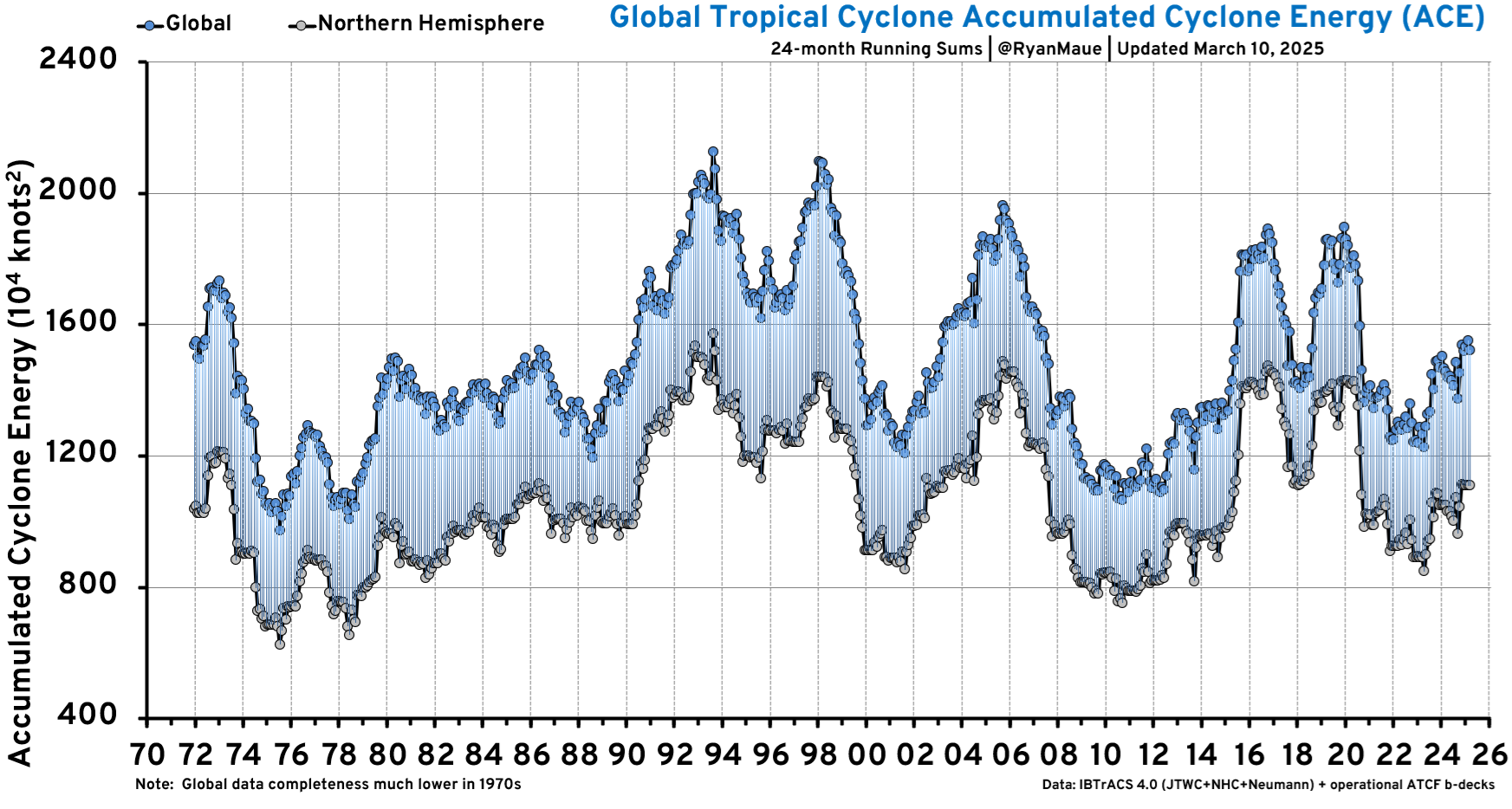
Also, there has been no sustained increase in Accumulated Cyclone Energy, a measure of intensity, over more than 50 years, as demonstrated in Figure 2 below.

The “rapid intensification” phenomenon that Gross cites as a hallmark of climate change is not new. As Climate Realism has documented repeatedly, improved satellite monitoring and better detection methods since the 1970s make today’s storms appear more frequent and extreme simply because modern technology captures every detail that earlier weather observers missed. Earlier storm intensities were also harder to measure, making today’s apparent “increase” partly a result of better weather detection technology such as satellites, radar, and continuous monitoring. Past storms often were very strong and intensified rapidly—they just weren’t observed continuously from space or by coastal technology such as NEXRAD Doppler Radar, which didn’t exist before 1990.
Gross also doesn’t account for other factors that impact water temperatures, like the strong El Nino event from 2023 to 2024 that produced unusually warm waters that persisted in 2025, and reductions in ship emissions that research suggests has contributed to warmer ocean temperatures as more sunlight reached and warmed the surface waters.
Moreover, when analyzing the long-term record, natural ocean cycles dominate hurricane variability. The Atlantic Multidecadal Oscillation (AMO) drives multi-decade swings in hurricane frequency and intensity. Periods of increased storm activity, such as those seen in the 1940s to 1960s, occurred during cooler global temperatures. The 1935 Labor Day Hurricane, for example, remains one of the most intense storms to ever hit the United States—and it happened long before modern carbon dioxide emissions were significant.
Yes, Hurricane Melissa was a powerful storm, and all other things being equal, warmer water should produce more powerful hurricanes. But all other things are not equal, and water temperature is just one factor driving hurricane formation and intensity. Nature has produced strong storms for centuries. To claim that a single storm “proves” anything about global climate change is a red herring—a rhetorical trick used to distract from the lack of long-term supporting data. The actual data speak louder than opinions and states it plainly: “Global hurricane frequency and intensity show no meaningful trend in response to global warming.”
Some opinion pieces are so factually deficient they don’t merit publication. Gross’ hyperbolic and inaccurate piece about Hurricane Melissa is one such piece. Sadly, the Detroit Free Press lacked the discernment and objectivity to deny Gross a platform for his patently false claims. Hurricanes have always been part of life on this planet. They wax and wane with natural ocean cycles—not carbon dioxide levels. What has changed isn’t the weather, it’s the narrative the mainstream media continues to push that climate change is responsible for everything bad.
Share this:

Discover more from Climate- Science.press
Subscribe to get the latest posts sent to your email.
You must be logged in to post a comment.