

From Climate Scepticism
By Scepticus
A guest post by John Cullen
An extended response to a criticism of the first charge in the rap sheet
Introduction
Across on Robin’s thread, a discussion arose about the moral responsibilities, if any, that our UK government may have while it persists with Net Zero in the light of the evident damage that the policy is doing to our society and our economy.
The discussion started to take off in earnest with my comment here which drew responses from several perspectives. However, I was unconvinced by those arguments that largely absolved the government of such responsibilities and so in reply, and in a slightly tongue-in-cheek way, I drew up a short rap or charge sheet of government failings as I perceived them to be.
My rap sheet elicited a critique, partly from a devil’s advocate perspective (i.e. from the Establishment’s perspective), that encouraged me to set out in more complete detail the case against the government. To avoid hijacking Robin’s important thread my long response was initially transferred to the Net Zero Democracy thread because my argument deals more with governance/democratic failings than with weaknesses in the policy itself. However, the arguments are sufficiently numerous and varied that a separate standalone article for them is probably more suitable, which is why this new thread has been created.
Please note that the argument below relates only to the defence of the first of the critiques made against my rap sheet – hence, other responses may follow from me and others in due course as we advance through the charges.
In order to demonstrate the asymmetry in the battle of ideas (and the battle for resources) between Establishment and sceptics it is necessary to consider both scientific and organisational issues.
SCIENTIFIC ISSUES
In a dangerous world, one of the key requirements of the government of a sovereign state is that it should be alert to threats. So as not to waste precious resources, government needs to classify those threats and address the most serious in a timely and proportionate manner. For example, coastal defence of an island nation against the sea is an ever-present concern to be addressed by the state itself. However, global warming/cooling might be viewed as another possible threat but, depending upon the cause(s), it may require concerted international action.
In the 1970s the consensus in the scientific climate community was that descent into a new ice age was an imminent possibility. In response the BBC produced a TV programme by Nigel Calder called ‘The Weather Machine’; it also produced a book with the same title [Ref. 1] but included a subtitle, ‘The Threat of Ice’. However, shortly afterwards, global temperatures started to increase, and the scientists started to worry instead about excessive global warming. It was conjectured that the increased concentration of atmospheric CO2, largely due to fossil fuel combustion by humanity, might be the primary driver of rising temperatures.
Because CO2 is, globally, a well mixed gas the governments of the world responded in a timely manner and set the global scientific community to study the matter (notably anthropogenic CO2 forcing rather than natural variability) with an expanding scientific workforce commensurate with the possibly existential risk; government bureaucracy, especially in the West, was also expanded to coordinate response to the perceived temperature and related climate change threats. The mainstream media also took increased and often lurid interest in the temperature rise projections of several degrees Celsius per century coming from the computer models of the climate. Models have their uses, but scientific endeavour requires measurements in order to base theory in physical reality.
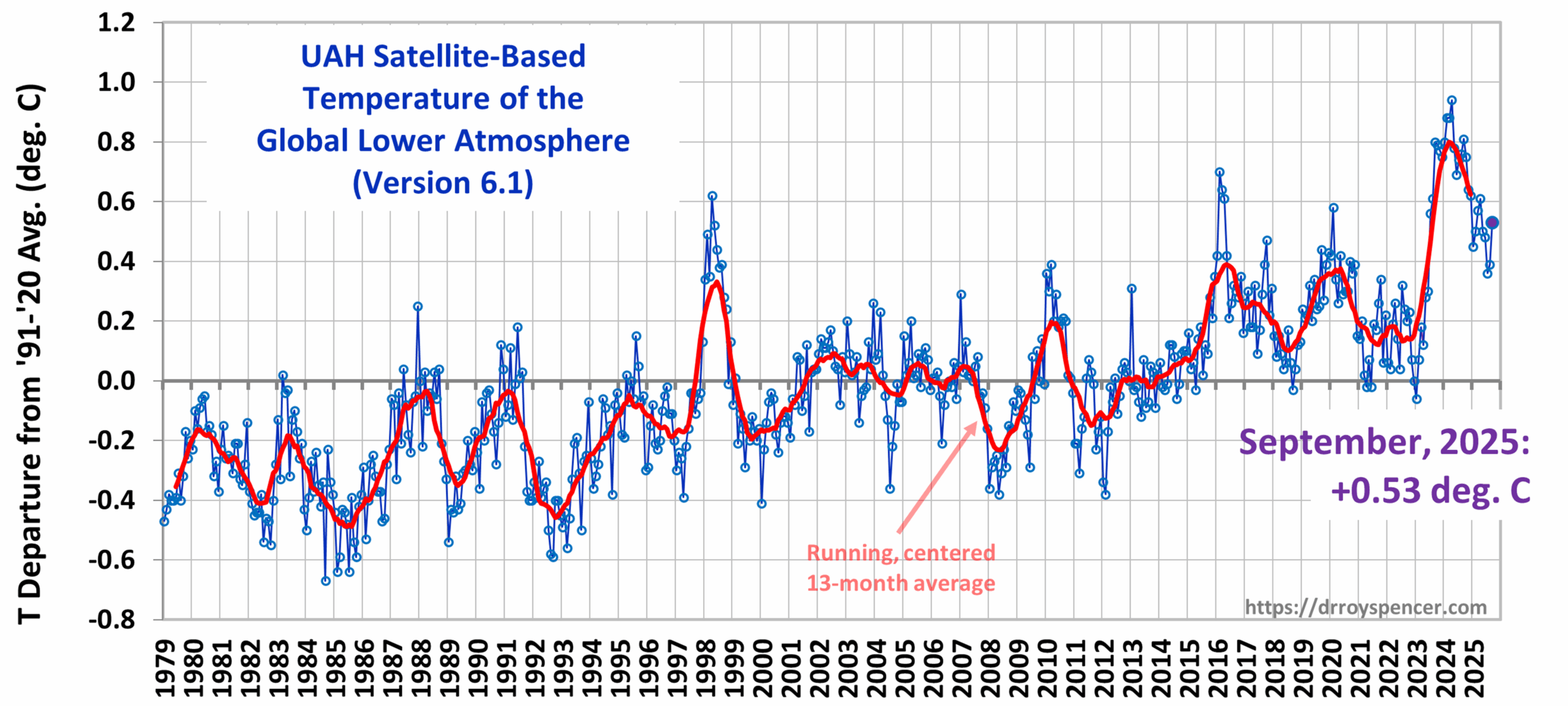
Fortunately, worldwide temperature measurements started to be available from 1979 with the first satellite-based temperature measurement technology [Ref. 2]. The satellite record is now the better part of half a century old and so comparison can be made between alarmist models and physical reality (with the latter measured by, and with agreement between, satellites and balloons/radiosondes).
The satellite measurements show that the global average temperature of the lower atmosphere is about one degree Celsius warmer now than when satellite records began [Note 1]. Temperature has been measured to rise and fall, typically over scales of about 4 years, with the current temperature having first been exceeded in 1998 (i.e. over 25 years ago in a record less than twice that age). It thus seems appropriate at this point to quote prof. Richard Lindzen, “The influence of mankind on climate is trivially true and numerically insignificant.”
Furthermore, it has been known for some 10 years that the majority of climate models predict greater warming than has been measured in practice [Refs. 4 and 5]. To quote from the Executive Summary of [Ref. 5],
The world’s several dozen global climate models offer little guidance on how much the climate responds to elevated CO2 … Global climate models generally run “hot” in their description of the climate of the past few decades … The combination of overly sensitive models and implausible extreme scenarios for future emissions yields exaggerated projections of future warming … Both models and experience suggest that CO2-induced warming might be less damaging economically than commonly believed, and excessively aggressive mitigation policies could prove more detrimental than beneficial … U.S. policy actions are expected to have undetectably small direct impacts on the global climate, and any effects will emerge only with long delays …
Given that (i) democratic governments typically have an electoral cycle of about 5 years, (ii) the physical temperature record (as contrasted to the output of computer models) shows only modest temperature rise over decades, and (iii) as just noted even large very economies (e.g. USA) are expected to have only a tiny and slowly-emerging influence on climate, the question arises, “Why have Western governments continued to spend so much time and treasure trying to mitigate (rather than adapt to) climate change? To try to answer that question it is necessary to consider organisational issues at national and international levels.
ORGANISATIONAL ISSUES
As noted above, governments have created armies of climate scientists and civil servants to address anthropogenic-driven climate change which seems to be, at worst, but a small and slowly emerging threat, or indeed a benefit when increased greening from CO2 fertilisation is included [Ref. 6]. In a dangerous but rational world such small threats/definite benefits would be relegated to ‘watching brief’ status in the nation’s risk register.
However, what is to be done with the aforementioned standing army of scientists and functionaries who, not wanting to lose their jobs [Refs. 7 and 8], argue for continued hyper-vigilance via the Precautionary Principle? Is there any mechanism to move them onto study more serious and more imminent threats? Well, without civil service etc. reform [Note 2] it appears, as reported by Endress [Ref. 9], that such change may be very difficult to achieve:
A particularly powerful type of rent-seeking coalition … is termed “the iron triangle” because of the strength of the collaborative relationships among a triad of actors: politicians … government bureaucrats … and private sector interest groups … The iron triangle is durable and impenetrable because it functions as a highly efficient, three-cornered, rent-seeking machine.
Endress continued with a prescient warning for our own days,
Nowhere (except perhaps in health care) do third-best politics sink … best economic considerations as deeply as in the realm of energy policy.
To illustrate briefly how scientists supporting the government’s alarmist warming case have contributed to iron triangle behaviour, it is helpful to understand the principles of best scientific practice. These were set out decades ago by Merton [Ref. 10], of which the following two are relevant for present considerations:-
…disinterestedness: scientific institutions act for the benefit of a common scientific enterprise, rather than for specific outcomes …
…organized skepticism: scientific claims should be exposed to critical scrutiny before being accepted: both in methodology and institutional codes of conduct.
Read a couple of comments [Ref. 11] by climate scientist prof. Phil Jones and consider whether they are consistent with best practice:-
(i) “I can’t see either of these papers being in the next IPCC report. Kevin and I will keep them out somehow – even if we have to redefine what the peer review literature is!”
(ii) “Why should I make the data available to you, when your aim is to try and find something wrong with it?”
For those wishing to pursue the many breaches of best scientific practice within the climate science community [Refs. 12 and 13], though slightly dated, may be useful. These breaches are highly important because they have helped to steer and distort government climate and energy policy over decades. The broader issue of separating climate politics from alarmism is addressed by prof. Mike Hulme in [Ref. 14].
Among the organisational failures arising from an energy policy that has been driven by climate alarmism are the omission of adequate risk and cost-benefit analyses justifying the rapid roll out of modern renewables rather than a considered, staged deployment starting with a variety of pilot projects. This failure has led to huge costs to be covered by tax- and energy bill-payers. Perhaps this failure is due in part to policy capture by activists, or as prof. Lindzen [Ref. 15] puts it,
To say that climate change will be catastrophic hides a cascade of value-laden assumptions that do not emerge from empirical science.
A further misdirection by the Establishment is to rely on the concept of ‘consensus’ within a highly contested scientific debate about a highly complex multifactorial topic such as climate [Note 3]. In a different context Albert Einstein had to deal with this issue about a century ago; my computer gave this AI overview of his situation,
When a book was published titled ‘One Hundred Authors Against Einstein’ to disprove his theory of relativity, he famously retorted, “Why one hundred? If I were wrong, one would have been enough!”. Einstein’s response highlighted the scientific principle that a single, valid contradictory fact is enough to disprove a theory, rather than the need for a collective opinion.
With all the distortions noted above it is perhaps unsurprising that Western governments (which, following World War 2, had invested so much political capital in the United Nations Organisation) have promoted the series of COP (Conferences of the Parties) as a vehicle for their ‘war’ on anthropogenic CO2. The COP of late 2009 in Copenhagen marked a watershed moment in the COP series; it was then and there that the West’s governments, notably Europe’s governments, failed to persuade the rest of the world to adopt an enforceable framework for CO2 reduction. As Rupert Darwall [Ref. 16] put it,
Now the Europeans were not only isolated. They had been crushed. For them, climate change was an existential issue. There could be no more important business than saving the planet … There was just enough in the Accord to keep the whole negotiating process going indefinitely and provide cover for European governments to continue with their global warming policies. Everything could go on much as before.
And so, some 16 years later, it still continues much as before i.e. with all the baked in errors of science, organisation and resultant policy.
CONCLUSIONS
I have attempted to show that climate and energy policy has been distorted due to significant scientific and organisational errors such that, although the Establishment (currently) enjoys numerical superiority over the sceptics, it does not enjoy superiority in the quality of its arguments – far from it! This asymmetry reveals itself also in public behaviour with the Establishment denigrating non-believers in the most derogatory terms; such denigration is not, I argue, warranted given the poor quality of the Establishment’s methodologies. Indeed, much needs to be done to set the Establishment’s house in order and thereby set the West (and notably the Europeans) back on the path to (i) reliable and affordable energy, (ii) much improved democratic governance, and (iii) scientific rectitude.
Finally, it may be appropriate to quote Einstein again [Ref 17], “The only thing more dangerous than ignorance is arrogance.” If the great man were alive today I wonder whether he would have anything to say about the combination of arrogance and wilful ignorance. They seem, from my perspective, to have been exceedingly destructive for the West in recent decades.
NOTES
- To put the 1 degree Celsius temperature rise in context it is helpful to recall that, in very approximate figures, global average surface temperature is 15 degrees Celsius and the absolute zero of thermal energy is minus 273 Celsius. Hence the 1 degree rise represents a change of less than half of 1% over about half a century.
- A major lesson to be taken from the response to the global warming issue is the need in every case to avoid one-sided or motivated reasoning; balanced argumentation (via, for example, red-v-blue team review) is always required. Claims such as, “The science is settled!”, should always viewed with the greatest scepticism [cf. Ref. 10].
- By contrast Maxwell’s discovery of the laws of electromagnetism (as set out in the equations named after him) enjoy an almost universal consensus because, although mathematically complex, they deal with a single domain of knowledge, whereas many scientific domains are involved in determining the even more complex topic of climate.
REFERENCES
- Nigel Calder, “The Weather Machine”, BBC, 1974. Note the subtitle on the dustcover, “And the Threat of Ice”.
- https://www.drroyspencer.com/wp-content/uploads/UAH_LT_1979_thru_September_2025_v6.1_20x9-scaled.png
- https://www.azquotes.com/author/30824-Richard_Lindzen
- Dr. John Christy (UAH) https://www.commerce.senate.gov/services/files/fcbf4cb6-3128-4fdc-b524-7f2ad4944c1d
- See chapter 5 of https://www.energy.gov/sites/default/files/2025-07/DOE_Critical_Review_of_Impacts_of_GHG_Emissions_on_the_US_Climate_July_2025.pdf
- https://wattsupwiththat.com/2022/04/23/increased-plant-productivity-the-first-key-benefit-of-atmospheric-co2-enrichment/
- Upton Sinclair, “It is difficult to get a man to understand something when his salary depends upon his not understanding it.”, https://www.azquotes.com/author/13641-Upton_Sinclair
- https://www.poetryfoundation.org/poems/51294/waiting-for-the-barbarians
- Lee H. Endress, chapter 3, page 58, in Arsenio M. Balisacan et al. (editors), “Sustainable Economic Development”, Academic Press, 2015.
- https://en.wikipedia.org/wiki/Mertonian_norms
- Fred Pearce, “The Climate Files”, guardianbooks, 2010, pages 138 and 143.
- A.W. Montford, “The Hockey Stick Illusion – Climategate and the Corruption of Science”, Stacey International, 2010.
- A.W. Montford, “Hiding the Decline”, Anglosphere Books, 2012.
- Mike Hulme, “Climate Change isn’t Everything”, polity, 2023.
- https://www.azquotes.com/quote/1450473
- Rupert Darwall, “The Age of Global Warming”, Quartet Books, 2014, pages 282 and 286.
- https://www.azquotes.com/quote/613503
Share this:

Discover more from Climate- Science.press
Subscribe to get the latest posts sent to your email.
You must be logged in to post a comment.