

From ClimateRealism

In a widely published Associated Press (AP) article, “Climate change fuels Hurricane Melissa’s rapid intensification to Category 5,” reporter Sibi Arasu claims that “the warming of the world’s oceans caused by climate change helped double Hurricane Melissa’s wind speed in less than 24 hours.” This is highly misleading if not outright false. Scientific data refute claims that climate change is causing more severe or frequent hurricanes.
The story cites the climate advocacy group Climate Central, which claims that climate change is making hurricanes “more likely to intensify quickly, especially near coastlines.” While it is true that warm water fuels hurricanes—meteorologists have known that for more than a century—long-term climate change cannot be blamed for the specifics of a single storm.
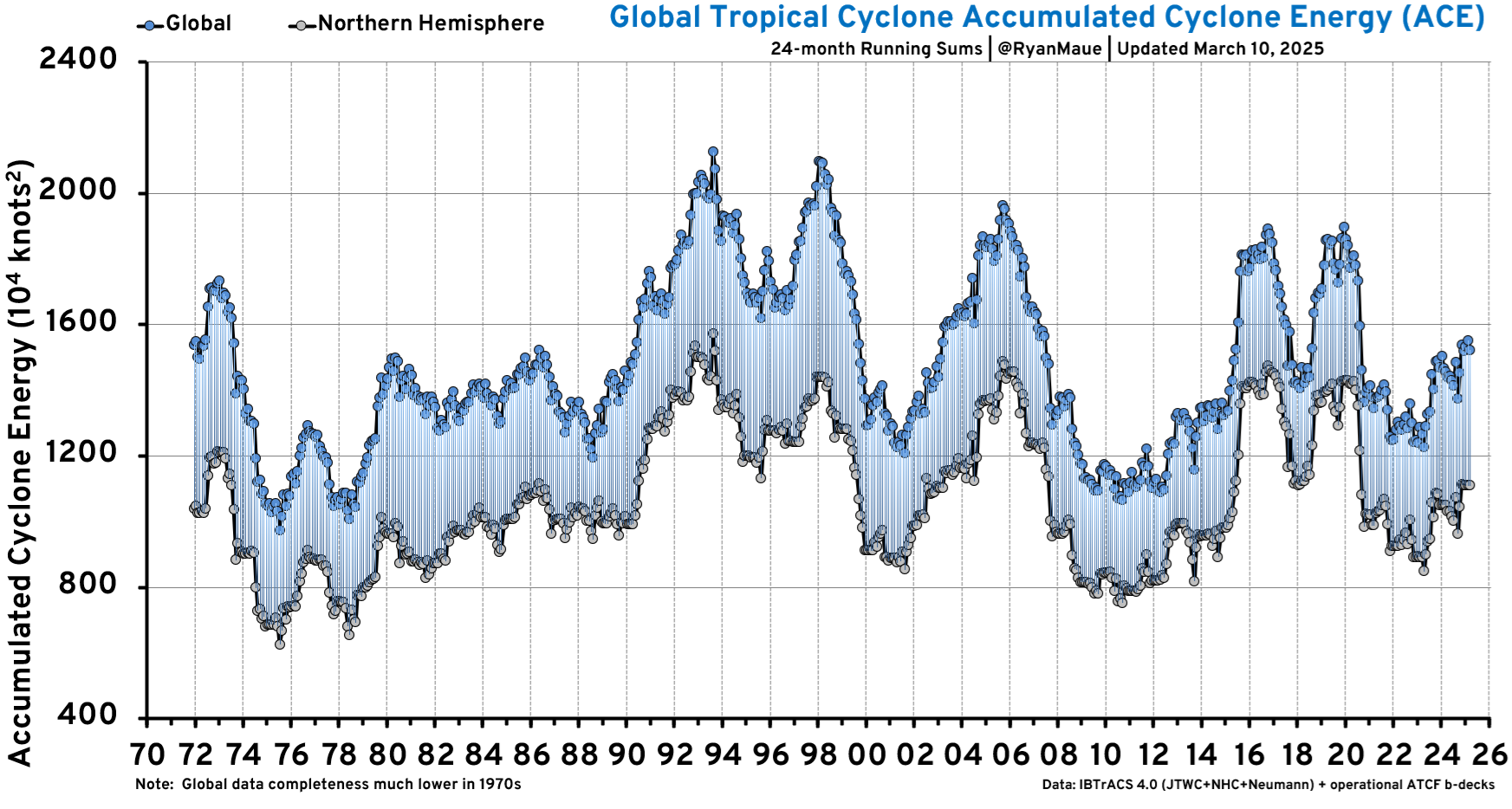
Contrary to what the AP says, as Climate at a Glance: Hurricanes explains, there has been no increase in the frequency or intensity of hurricanes over the past century, even as carbon dioxide concentrations have risen. For example, Figure 1 below shows the Accumulated Cyclone Energy, a measure of intensity, over more than 50 years, and there is no increase.

The National Oceanic and Atmospheric Administration’s Historical Hurricane Tracks database shows that hurricane activity fluctuates naturally, with the 1940s through 1960s being among the most active periods on record—long before modern fossil fuel emissions were significant.
Even the Intergovernmental Panel on Climate Change (IPCC) acknowledges that there is “low confidence in any long-term trends in hurricane activity.” The IPCC’s Sixth Assessment Report found no detectable increase in either global tropical cyclone frequency or landfall intensity. See the table below from the IPCC report and note the highlighted section on tropical cyclones:

In plain English, data show the number of hurricanes are not increasing, nor are they demonstrably stronger.
Hurricanes need a lot more than just warm ocean water to form. Atmospheric conditions—such as vertical wind shear, mid-level humidity, the difference between air and water temperatures, and steering patterns—determine whether a storm strengthens or weakens. These are chaotic, short-term variables, not predictable climate trends. Also, there is no evidence that climate change impacts any of those other variables. Hurricane Melissa’s rapid intensification was a weather event, not evidence of a new climate regime.
The AP’s article claims that “Atlantic hurricanes are now more than twice as likely to intensify rapidly from minor storms to powerful and catastrophic events,” referencing a Scientific Reports paper. This statistic, when scrutinized, is questionable because it relies on satellite-era observations that began only in the 1970s. Earlier storm intensification rates were harder to measure, making today’s apparent “increase” partly a result of better weather detection technology such as satellites, radar, and continuous monitoring. The statistic also doesn’t account for other factors that impact water temperatures, like El Nino events that warm waters, and reductions in ship emissions that research suggests has contributed to hotter measured ocean temperatures.
The AP uncritically quotes a Climate Central meteorologist who says, “[w]e can’t stop hurricanes, but we can reduce the risk by cutting emissions.” That statement has no basis in science—it’s advocacy. Reducing CO₂ will not meaningfully change hurricane formation in the Atlantic, where natural cycles like the Atlantic Multidecadal Oscillation (AMO) play a far greater role in modulating storm activity.
The fact that Hurricane Melissa reached Category 5 intensity hardly makes it unique. Historical records show similar or stronger storms in the past—such as the 1935 Labor Day Hurricane, which struck the Florida Keys with estimated winds of 185 mph. That storm occurred during a much cooler global climate period, which disproves both the idea that powerful hurricanes are a modern phenomenon and that they are caused by global warming.
The AP also ignores the fact that surface temperatures in the tropical Atlantic naturally vary by several degrees Celsius over multidecadal cycles. The recent warming period that fueled Melissa is part of a recurring oceanic pattern, not proof of an unprecedented climate trend driving hurricane intensity.
The article concludes by invoking moral urgency—quoting island-nation negotiators who say storms like Melissa “make it more urgent for countries to act on climate change.” But this is emotional rhetoric, not evidence. Hurricanes have battered the Caribbean for millennia. The only thing “unprecedented” is how newsrooms now attribute every storm to climate change while ignoring the long, cyclical record of similar events.
In short, the AP story is a red herring. Warm water helps hurricanes, but that has always been true. There’s no credible long-term evidence of more frequent or intense storms, and no justification for tying one hurricane to global climate change. The data say otherwise.
By turning a single weather event into a climate morality tale, The Associated Press misleads its readers and betrays journalistic objectivity. Hurricanes, even powerful hurricanes like Melissa are meteorology, not ideology. It is long past time for reporters to acknowledge the difference.
Anthony Watts is a senior fellow for environment and climate at The Heartland Institute. Watts has been in the weather business both in front of, and behind the camera as an on-air television meteorologist since 1978 and currently does daily radio forecasts. He has created weather graphics presentation systems for television, specialized weather instrumentation, as well as co-authored peer-reviewed papers on climate issues. He operates the most viewed website in the world on climate, the award-winning website wattsupwiththat.com.
Share this:

Discover more from Climate- Science.press
Subscribe to get the latest posts sent to your email.
You must be logged in to post a comment.