

From Science Matters
By Ron Clutz

Beware false and misleading Cartoons.
A brief recent video by Markus Ott explains why the notion of “back radiation” in Earth’s climate should be laid to rest. I provide a transcript text in italics with my bolds and key exhibits.
Ott/Shula: The second law of thermodynamics and the greenhouse effect
This is the first of a short series of physics videos. This series is intended to be a follow up to Tom Shula’s presentation in which we can take more time to go into the fundamentals and derivations of our results. Since Tom and I are attacking the foundations of modern climate science, it makes sense to start with the thermodynamic aspects of the greenhouse effect.
In this video I will not talk about greenhouse gas molecules. I will look at the Green House Effect from the perspective of classical thermodynamics. Classical thermodynamics describes matter as a continuum and does not care about the atomic or molecular structure of matter. The laws of thermodynamics have proven to be universally valid hypotheses, and theories that contradict the laws of thermodynamics have always proved to be wrong
In connection with the greenhouse effect, the second law of Thermodynamics is particularly interesting. There are various equivalent formulations for the second law of thermodynamics which states that thermal energy cannot be completely converted into other forms of energy. Rudolf Clausius was the first to formulate the second law in the form that heat does not flow spontaneously from cold to hot bodies. Later in 1865 he developed on that basis the concept of entropy.

Those who believe in thermodynamics categorize this statement as an eternal truth and therefore find it very difficult to understand how the greenhouse effect is supposed to work. How can the atmosphere which is mostly colder than the Earth’s surface heat the Surface by means of back radiation, and by as much as 33°C? Greenhouse effect believers like to refer to Carl Schwarzschild’s 1906 paper About the equilibrium of the solar atmosphere to answer this question.
In order to clarify this question of faith we will take a closer look at this much cited and probably rarely read article which was written in a German adequate to a highly educated man. I posted a manual translation of the text on my substack page. Without going into the details of his calculations we will look at how Schwarzschild comes to the conclusion that the sun’s atmosphere not only radiates outwards into space but that a significant proportion of radiation is also directed inwards towards the base of the sun’s atmosphere.
Such an inward or downward back radiation can also be measured at the bottom of the Earth’s atmosphere. This observation is taken as a reason to postulate a similar radiation equilibrium in the Earth’s atmosphere. The greenhouse effect is said to be the result of that back radiation.
The starting point for Schwarzschild’s article is the observation that the brightness of the visible solar disc is not evenly distributed. The brightness decreases towards the edge. The diagram shows the observed brightness distribution as a blue line. Schwarzschild compares two conceivable mechanisms of heat transport through the solar atmosphere in order to determine the cause of this brightness distribution. Heat transport through radiative transfer which requires a radiative equilibrium in the Solar atmosphere, and heat transport by convection with an adiabatic equilibrium in the Solar atmosphere.

He calculates how the brightness distribution on the solar disc should be for these two cases. Because his results for the radiative equilibrium Orange Line in the diagram matched the observed brightness distribution Blue Line better than his results for the adiabatic equilibrium Gray Line, he assumes that a radiative equilibrium prevails in the Solar atmosphere. We will disregard his description of the adiabatic equilibrium here and restrict ourselves to his description of the radiative equilibrium.

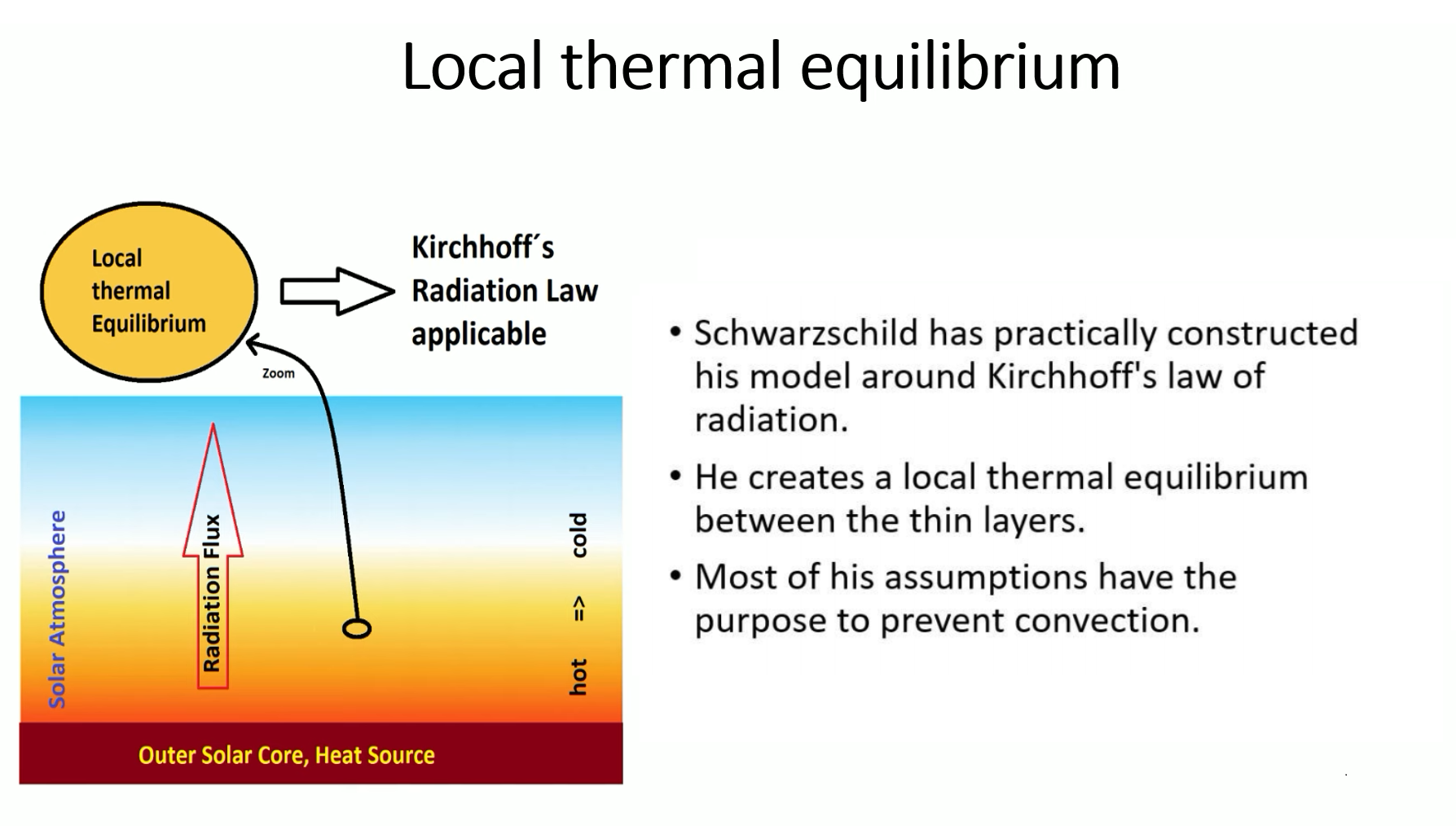
Kirchhoff’s law of radiation plays a central role in Schwarzschild’s model. Kirchhoff’s law of radiation describes the relationship between absorption and emission of a real body in thermal equilibrium. It states that radiation absorption and emission correspond to each other for a given wavelength. A body that absorbs well also radiates well. This can be visualized as follows: We consider a body 2 that is located in a cavity of another body 1. Vacuum prevails in the intermediate space. If both bodies have the same temperature the radiant power absorbed by Body 2 must be the same as the radiant power emitted by it because otherwise the temperature of body 2 would change. This means that in thermal equilibrium Kirchhoff’s law of radiation represents a kind of radiation energy conservation law for body 2.

The layout of Schwarzschild’s radiative transfer model of the solar atmosphere is quite simple. An unknown heat source in the core of the Sun generates heat; a possible liquid outer core transports this heat by convection to the bottom of the solar atmosphere; the heat is then transported outwards into space solely by radiative transfer. He does not go any further into the properties of the sun’s core. He only assumes that the core heats the solar atmosphere evenly at its boundary surface. It is very important that this heating occurs so evenly that convection currents do not form in the Solar atmosphere.
In Schwarzschild’s model the solar atmosphere is assumed to have the following properties:
♦ the solar atmosphere is stably stratified without convection.
♦ temperature and density increase continuously from the top of the atmosphere to the ground
♦ the vertical profile of temperature is smaller than the adiabatic vertical profile.
♦ each layer of the sun’s atmosphere absorbs and emits radiation without loss.
♦ the energy flow which flows from an unknown source inside the Sun through the solar atmosphere into the outer space is in a steady state.
Since a downwelling radiation is also measurable on the ground of Earth’s atmosphere, modern climate science assumes that Schwarzschild’s radiation transfer model is also applicable to our atmosphere. Now let’s take a look at the applicability of Schwarzschild’s model to the Earth’s atmosphere.

It is striking that Schwarzschild has practically constructed his model around Kirchhoff’s law of radiation. He has to make a number of not particularly plausible assumptions in order to create a local thermal equilibrium between the layers of his solar atmosphere. As mentioned before most of these assumptions serve to prevent convection in his model. This is critically important because as soon as convection comes into play, the condition of local thermal equilibrium is no longer fulfilled. The vertical convection currents and the associated turbulence destroy Schwarzschild’s homogeneous stratification of the atmosphere. Large local temperature jumps occur Kirchhoff’s law of radiation is therefore no longer applicable.
To summarize and formulate this somewhat more abstractly: In order to create the conditions for Pure radiation transport through the solar atmosphere Schwarzschild must construct an atmosphere with a very high degree of order. In liquid or gaseous systems even, minor disturbances will cause such a state to change into a disordered convective State. Under convective conditions Kirchhoff’s law of radiation and thus the radiative transfer equation are not valid.

This transition to the convective state takes place with a large entropy gain. It is therefore spontaneous and irreversible. Accordingly, there should be no radiative transfer and no greenhouse effect in our troposphere since it is dominated by convection currents.
Look at a volume element under convective conditions such as those that prevail in our troposphere. The volume element absorbs radiation and converts the radiation energy into heat. Before it can convert the heat back into radiation it is caught by a convection current and lifted. This causes it to move into areas with lower ambient pressure. It expands and performs volume work in the process. It draws the energy for this volume work from its heat content and therefore cools down. The amount of heat that the volume element has converted into volume work can no longer be converted back into radiation. The conservation of radiation energy is therefore no longer given.
Kirchhoff’s law of radiation can no longer be applied to the volume element. The entropy of the volume element increases the process is irreversible lifting and acceleration. Work performed by the volume element derives their energy from the heat content of the volume element and also contribute to the irreversibility of radiation absorption under convective conditions. Global circulations also affect these processes but that will be discussed in another video.
I would like to point out that radiation absorption and emission are irreversible processes. In themselves the reemission of radiation from an excited molecule occurs randomly in any direction. This means that the information about the direction of the previously absorbed radiation is lost during emission The emitted Photon transfers part of its momentum to the emitting molecule. Its energy and therefore also its frequency are therefore different from that of the previously absorbed Photon. Schwarzschild also excludes these effects through his choice of boundary conditions: steady state radiation flux and frequency independence of absorptivity and emission.
In one of my previous videos, I made fun about the fact that the 33° greenhouse effect is calculated by assuming that the solar Radiance is homogeneously distributed over the Earth’s surface with 240 W per square meter. Now with a deeper understanding of Schwarzschild’s model we get an idea about the origin of this rather strange assumption. In his radiation transfer model, the base of the solar atmosphere is heated internally and homogenously by the solar core. This homogeneous heating is very important since an inhomogeneous heating would cause convection which is incompatible with Kirchhoff’s law of radiation and would spoil his model. In a rather hapless attempt to apply Schwarzschild’s radiation transfer model, the same is done to the externally and unevenly heated surface of the Earth.
To summarize briefly the irreversibility of radiation absorption in air under convective conditions makes back radiation and thus the greenhouse effect impossible. This statement seems to be in direct contradiction to the observation that a downwelling atmospheric radiation can be measured at the bottom of the Earth’s atmosphere. The diagram here shows the measured values from a measuring station near Munich. In the next video I will show that back radiation is not what most people think of it to be, and how it is compatible with the laws of thermodynamics.
The most important takeaway from this video is that Kirchhoff’s law of radiation presents a kind of radiation energy conservation law, and that this radiation energy conservation is not given under convective conditions. As far as I know all radiation transfer models assume a universal validity of Kirchhoff’s law of radiation. The only exception is at very high altitudes where the air molecules only very rarely collide with each other. Since the results of the radiation transfer models are based on this false basic assumptions, they are wrong.

That is not to say that Carl Schwarzschild’s work is nonsense. His original idea is very applicable to transparent systems without convection, for example in the production of large telescope mirrors. The cooling behavior after the glass mass has solidified can be described very well using radiation transfer methods.
Footnote Regarding Observation of Downwelling IR near Earth Surface

From Andy May Beyond CO₂: Unraveling the Roles of Energy, Water Vapor, and Convection in Earth’s Atmosphere
Because the humid lower atmosphere is nearly opaque to most surface emitted radiation that is outside the atmospheric windows, surface emissions are absorbed by GHGs very close to the surface. According to Heinz Hug, at sea level, with a CO2 concentration of 357 PPM and 2.6% water vapor, 99.94% of all surface radiation in the main CO2 frequency band at about 15 μm is normally absorbed in the lower 10 meters of the atmosphere (Hug, 2012). Even at the edges of the deep CO2 frequency band (see figure 1, as well as figures 4 & 5 here) where any increase in the CO2 effect would be observed, 99.9% of the surface radiation is absorbed in the first 690 meters (Hug, 2000).
Heinz Hug goes on to say that is why climate change caused by CO2 cannot be measured directly in the laboratory and can only be modeled. In our opinion, the effect of CO2 is so small it will likely never be measured. In a similar fashion, any “back radiation” that makes it to the surface, outside atmospheric windows, is from the lower 10 meters of the atmosphere, the remaining emissions from the lower 10 meters of the atmosphere are captured by other greenhouse gases, almost always water vapor molecules.
Surface emissions in the frequencies that cannot be absorbed or emitted by GHGs, those in the so-called “atmospheric windows” are not captured, these are the frequencies utilized by IR thermometers and scanners, typically 7.5 to 14 micrometers as shown in figure 1. Water vapor is often a very weak absorber and emitter in portions of these windows. Carbon dioxide strongly absorbs and re-emits IR at two key frequencies: around 4.26 μm (microns) and 14.99 μm. The common vanadium oxide (VOx) based microbolometer long-wave infrared detectors cover wavelengths from 8-14 µm range. So, both CO2 absorption bands are outside the range of the common hand-held infrared thermometer/bolometer.
The radiation seen when IR thermometers and scanners are pointed at the sky is surface radiation scattered by atmospheric particles and clouds. The radiation seen by IR thermometers and scanners cannot be emitted by greenhouse gases or clouds because neither GHGs nor clouds emit in frequencies that can be detected by the devices. As noted in van Wijngaarden and Happer (2025) scattered longwave IR originates only in water droplets or ice or other particulates, there is negligible scattering of IR by molecules, especially in the atmospheric windows.
Background Paper with complete discussion
Missing Link in the GHE, Greenhouse Effect, by Thomas Shula – Markus Ott, USA – Germany
2024.
From Andy May Beyond CO₂: Unraveling the Roles of Energy, Water Vapor, and Convection in Earth’s Atmosphere
Because the humid lower atmosphere is nearly opaque to most surface emitted radiation that is outside the atmospheric windows, surface emissions are absorbed by GHGs very close to the surface. According to Heinz Hug, at sea level, with a CO2 concentration of 357 PPM and 2.6% water vapor, 99.94% of all surface radiation in the main CO2 frequency band at about 15 μm is normally absorbed in the lower 10 meters of the atmosphere (Hug, 2012). Even at the edges of the deep CO2 frequency band (see figure 1, as well as figures 4 & 5 here) where any increase in the CO2 effect would be observed, 99.9% of the surface radiation is absorbed in the first 690 meters (Hug, 2000).
Heinz Hug goes on to say that is why climate change caused by CO2 cannot be measured directly in the laboratory and can only be modeled. In our opinion, the effect of CO2 is so small it will likely never be measured. In a similar fashion, any “back radiation” that makes it to the surface, outside atmospheric windows, is from the lower 10 meters of the atmosphere, the remaining emissions from the lower 10 meters of the atmosphere are captured by other greenhouse gases, almost always water vapor molecules.
Surface emissions in the frequencies that cannot be absorbed or emitted by GHGs, those in the so-called “atmospheric windows” are not captured, these are the frequencies utilized by IR thermometers and scanners, typically 7.5 to 14 micrometers as shown in figure 1. Water vapor is often a very weak absorber and emitter in portions of these windows. Carbon dioxide strongly absorbs and re-emits IR at two key frequencies: around 4.26 μm (microns) and 14.99 μm. The common vanadium oxide (VOx) based microbolometer long-wave infrared detectors cover wavelengths from 8-14 µm range. So, both CO2 absorption bands are outside the range of the common hand-held infrared thermometer/bolometer.
The radiation seen when IR thermometers and scanners are pointed at the sky is surface radiation scattered by atmospheric particles and clouds. The radiation seen by IR thermometers and scanners cannot be emitted by greenhouse gases or clouds because neither GHGs nor clouds emit in frequencies that can be detected by the devices. As noted in van Wijngaarden and Happer (2025) scattered longwave IR originates only in water droplets or ice or other particulates, there is negligible scattering of IR by molecules, especially in the atmospheric windows.
Background Paper with complete discussion
Missing Link in the GHE, Greenhouse Effect, by Thomas Shula – Markus Ott, USA – Germany
2024.
Share this:

Discover more from Climate- Science.press
Subscribe to get the latest posts sent to your email.
You must be logged in to post a comment.