

From NoTricksZone
To claim that anthropogenic CO2 emissions drive global warming, radiative forcing modeling studies must assume 1) clouds do not ever change, 2) cloud albedo is constant, and/or 3) clouds do not exist. None of these are real-world conditions.
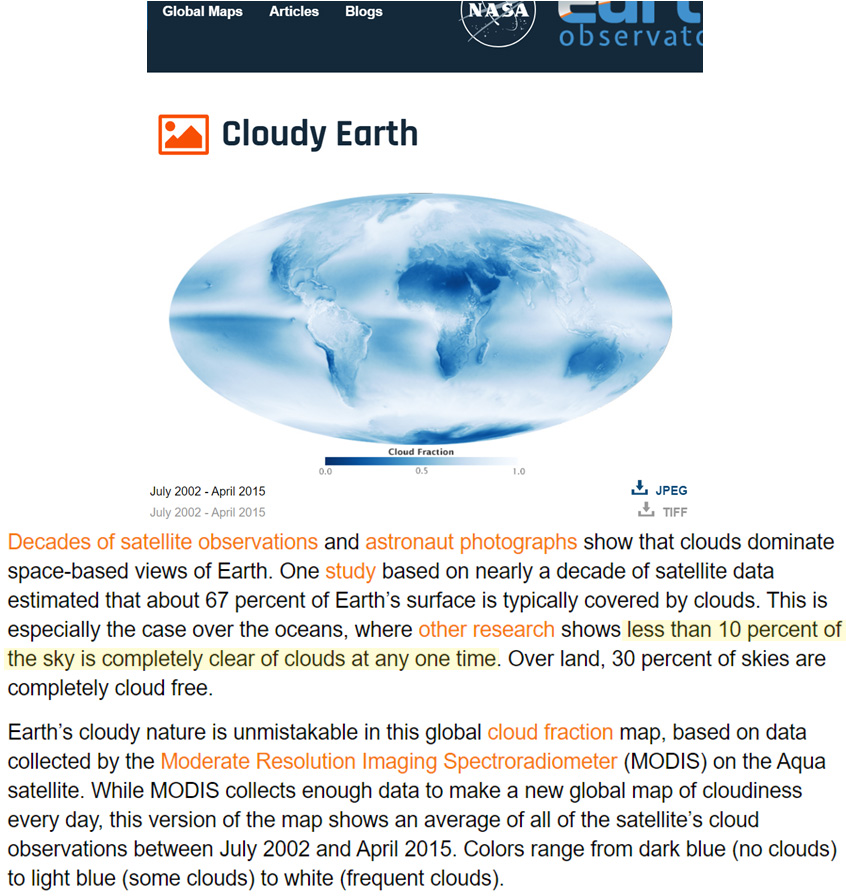
The real atmosphere is what scientists refer to as all-sky, an atmosphere where clouds not only exist but they are present 70-90% of the time.
In the real world clouds also “regulate the Earth’s climate,” as they are “the most important parameter controlling the radiation budget, and, hence, the Earth climate” (Sfîcă et al., 2020, Lenaerts et al., 2020).

Studying all the factors contributing to Earth’s Energy Imbalance (EEI) means we must consider the controlling, regulating dominance of the cloud radiative effect. Isolating selected factors like well-mixed greenhouse gases (CO2, CH4) while simultaneously excluding the cloud radiative effect only serves to advance a narrative about what is believed to occur an imaginary world where clouds are constant or do not exist.
Succinctly, an all-sky atmosphere analysis means cloud radiative effects are included in the calculations. A clear-sky analysis excludes the radiative effect of clouds.
Modeling studies purporting to isolate the radiative effect of anthropogenic emissions of CO2 and other greenhouse gases can only refer to clear-sky conditions – an Earth atmosphere that does not exist in reality.
Recently, Kramer et al. (2021) has received a lot of attention as a study robustly supporting the claim we humans have been and continue to control the climate with our CO2 emissions. They use a modeling “technique” that is claimed to isolate the human contribution to the radiative forcing from the “total radiative changes” from 2003 to 2018.
“We use the radiative kernel technique to isolate radiative forcing from total radiative changes and find it has increased from 2003 to 2018, accounting for nearly all of the long-term growth in the total top-of-atmosphere radiation imbalance during this period.”
However, the authors acknowledge that to arrive at their conclusion that anthropogenic CO2 is the dominant radiative forcing factor, their modeling calculations can only apply to an imaginary-world, clear-sky-only atmosphere. They admit radiative modeling for an all-sky world is “not possible.” So they assume clouds are constant, and that cloud albedo variations neither exist or affect climate. Hence, their study does not use real-world observational evidence; it only uses modeled calculations for a world that does not exist in reality.
“For all-sky conditions, an analogous calculation…requires the [instantaneous radiative forcing from all factors affecting climate] be known, [and thus] this differencing technique is not possible.”
“…we estimate Cl [cloud cover] is a constant…”
“For the [longwave impact from clouds] we use a constant of 1.24, derived from dividing clear-sky and all-sky double-call radiative transfer calculations of CO2 [instantaneous radiative forcing] from models.”
“This conversion to all-sky conditions accounts for the presence of clouds but not cloud changes. Therefore, the [instantaneous radiative forcing] in this study does not include aerosol-cloud interactions, such as cloud albedo effects.”

Feldman et al. (2015) is another study that anthropogenic global warming (AGW) apologists often claim provides “observational” evidence of the dominance of CO2 forcing in climate change. But, of course, this widely-heralded study also only has radiative calculations applying to an imaginary world where clouds do not exist (clear-sky). The authors even admit in the abstract that CO2’s radiative effects can only impact 10% of the longwave forcing trend in clear-sky.

Song et al. (2016) provide an excellent illustration of the reason why AGW-promoting studies only reference imaginary-world, clear-sky conditions and simultaneously exclude real-world conditions, or all-sky.
From 2003-2014, the total greenhouse effect forcing trend can be shown to be positive (blue) – but only for clear-sky conditions where CO2 and water vapor are presented as the drivers. This supports the position that rising CO2 and other greenhouse gases are enhancing the greenhouse effect as they rise.
But clouds exist, and all-sky is reality. And, in contrast to the clear-sky trend, the all-sky greenhouse effect impact (where clouds are considered as a radiative forcing factor in climate) is negative (red). The greenhouse effect is not enhanced, but devolves to a decline or a “hiatus” when clouds are considered.
“Therefore, although the greenhouse effect can be enhanced by increasing GHGs and water vapor in the atmosphere, it can be weakened by decreasing clouds. If these two actions offset each other, a hiatus of the global greenhouse effect will result.”

Of course, AGW apologists do not want us to see what happens when we fail to pretend clouds do not exist, or that clouds are not variable, but constant. They know cloud radiative effects destroy the humans-did-it narrative.
Share this:

Discover more from Climate- Science.press
Subscribe to get the latest posts sent to your email.
You must be logged in to post a comment.