

So the warming in recent decades may be natural. The CO₂ increases resulting from the natural warming may be substantially natural too. And these results are observationally supportable.

From NoTricksZone
By Kenneth Richard on 17. October 2023

Per a new study, atmospheric CO2 levels rose to 383 ppm in the 1940s mostly as a consequence of soil respiration processes and sea surface temperature warming. Any anthropogenic contribution to this CO2 peak “can be largely excluded.”
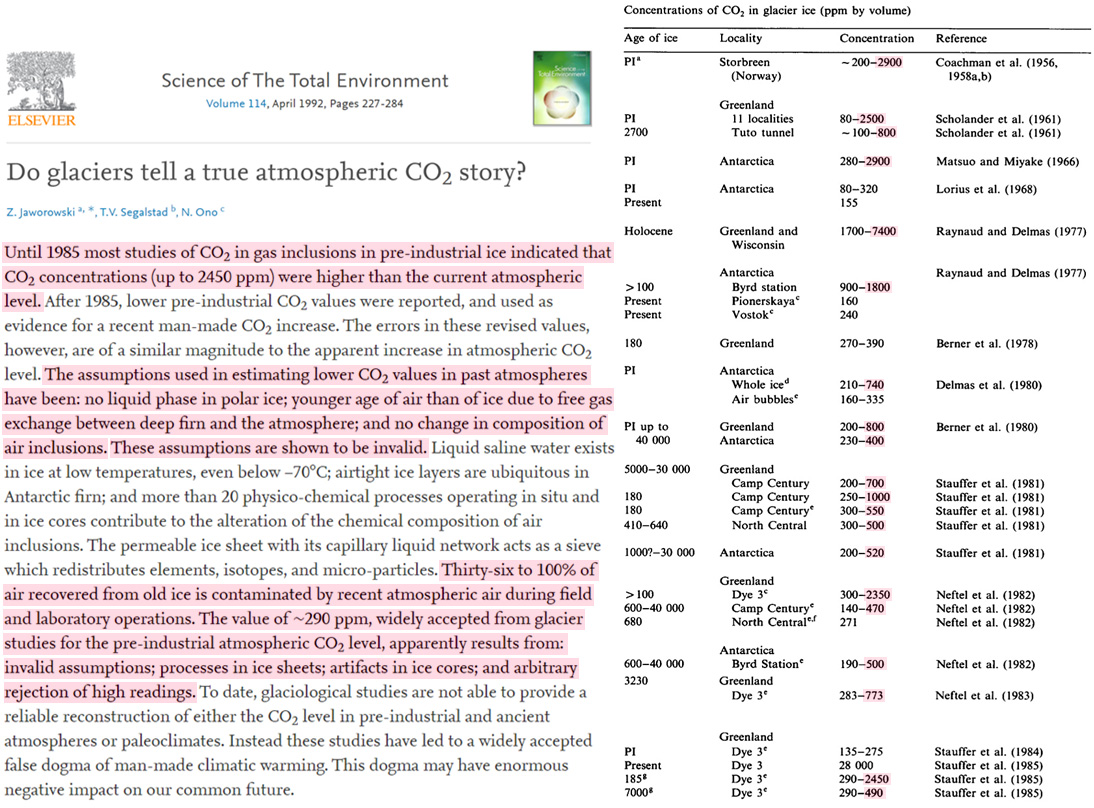
When assessing the historical atmospheric CO2 concentration, direct measurements of chemically analyzed air samples are at least 10 times more accurate than data derived from the commonly-accepted proxy records from ice cores (Harde, 2023).

The proxy data are subject to a great deal of selection bias, and thus the claim modern CO2 levels are uniquely due to human activity can seemingly be supported by using preferred data selection.
The late Dr. Ernst-Georg Beck spent years compiling an exhaustive chemical database of the CO2 levels measured in air samples from across the globe. Analyzing 979 technical papers reporting from 1,901 air sample measurement stations, Beck’s CO2 measurement data was published in a scientific paper entitled “Reconstruction of Atmospheric CO2 Background Levels since 1826 from Direct Measurements near Ground” after his death in 2022.
The CO2 variability in the measured data profoundly deviate from the far-less-accurate proxy data derived from one single continent’s (Antarctica) ice samples. The 60,000 global-scale chemical measurements compiled between 1930 and 1950 using data from 25 authors and locations assessed that between 1939 and 1943 global atmospheric CO2 rose to 383 ppm – the same concentration again achieved in 2007. After the early 1940s, the chemical measurements indicate CO2 plummeted to 310 ppm by the late 1940s.
These fluctuations are consistent with variations in sea surface temperatures (warmer water releases more CO2, cooler less) and temperature-dependent soil respiration (with mixing ratios ranging between 500 and 20,000 ppm) processes, suggesting that temperature is the driver, and CO2 variations are the effect. This T→CO2 directionality found in measured CO2 air sample data from 19th to mid-20th century is also evident for the satellite era.
Furthermore, the analysis reveals that of the 90 ppm rise in CO2 since 1958 (the Mauna Loa era), not more than 12 ppm could be said to have derived from fossil fuel emissions. And when the CO2 rose to 383 ppm in the early 1940s, the impact from anthropogenic emissions “can be largely excluded.”

Share this:

Discover more from Climate- Science.press
Subscribe to get the latest posts sent to your email.
You must be logged in to post a comment.